
Description
Maîtrisez la grammaire anglaise avec ce guide complet.
Sommaire
Guide Complet de Grammaire et d’Exercices d’Anglais
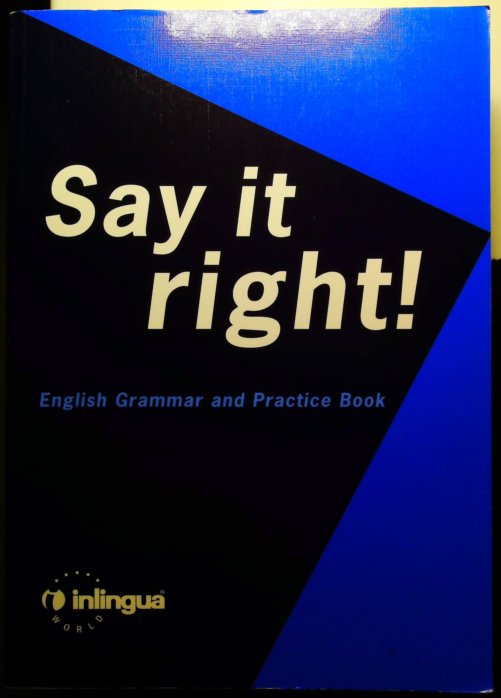
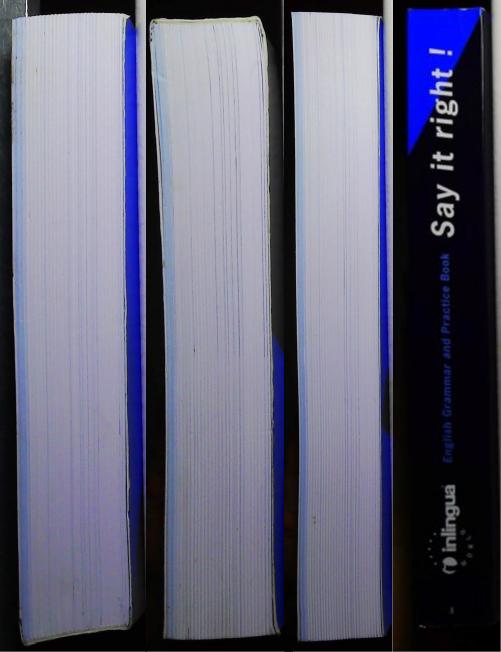
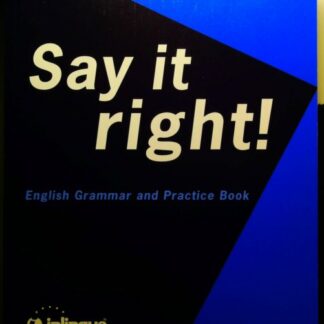
L’ouvrage Say it right! – English Grammar and Practice Book est un manuel pratique et complet. Il a été conçu par un collectif de spécialistes pour l’édition Inlingua. Ce livre se focalise sur la grammaire anglaise. Il propose également de nombreux exercices de mise en pratique. Ce titre est essentiel pour les recherches sur grammaire anglaise exercices, Say it right! Inlingua, et manuel de pratique anglais.
Ressource Pédagogique pour Maîtriser l’Anglais Correct
Ce manuel est structuré pour permettre une progression efficace. Il couvre les règles grammaticales fondamentales. Il vise à aider les apprenants à s’exprimer correctement en anglais. L’approche est centrée sur la pratique. Le livre est adapté aux étudiants de tous niveaux cherchant à perfectionner leur niveau. Il est une aide précieuse pour l’apprentissage de la langue anglaise.
Un Volume de Référence de 440 Pages (Édition Inlingua)
Le livre est un volume conséquent de 440 pages. Ce format atteste de l’exhaustivité du contenu. L’éditeur est Inlingua, un nom reconnu dans l’enseignement des langues. Le dépôt légal date de 2010. Ces informations confirment sa pertinence comme outil d’étude contemporain. Il est recherché par les centres de formation et les autodidactes.
ISBN pour une Édition Standardisée et Reconnue
L’ouvrage est identifié par l’ISBN 9783952209264. Cette référence permet de garantir l’authenticité de l’édition. Il s’agit d’un outil pédagogique fiable pour l’étude approfondie de l’anglais. Il est indispensable pour quiconque souhaite solidifier ses bases grammaticales et développer ses compétences.
Caractéristiques
-
Titre : Say it right! – English Grammar and Practice Book
-
Auteur : Collectif
-
Éditeur : Inlingua
-
Format : Non spécifié (440 pages)
-
Date de dépôt légal : 2010
-
ISBN-13 : 9783952209264
-
Thème : Langue anglaise, Grammaire, Exercices, Pédagogie
Table des matières
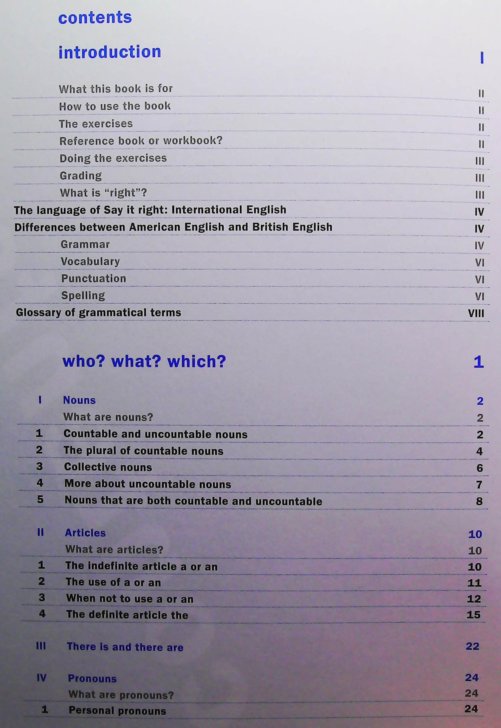
Contents
Introduction
What this book is for ••• I
How to use the book ••• II
The exercises ••• II
Reference book or workbook? ••• II
Doing the exercises ••• III
Grading ••• III
What is “right”? ••• III
The language of Say it right: International English ••• IV
Differences between American English and British English ••• IV
Grammar
Grammar ••• V
Vocabulary ••• VI
Punctuation ••• VI
Spelling ••• VI
Glossary of grammatical terms ••• VIII
who? what? which?
I. Nouns
What are nouns? ••• 2
Countable and uncountable nouns ••• 2
The plural of countable nouns ••• 4
Collective nouns ••• 6
More about uncountable nouns ••• 7
Nouns that are both countable and uncountable ••• 8
II. Articles
What are articles? ••• 10
The indefinite article a or an ••• 10
The use of a or an ••• 11
When not to use a or an ••• 12
The definite article the ••• 15
III. There is and there are ••• 22
IV. Pronouns
What are pronouns? ••• 24
Personal pronouns ••• 24
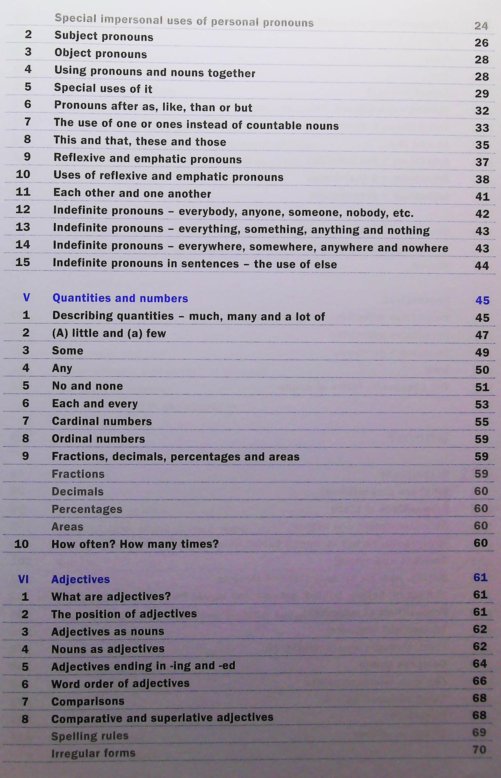
Special impersonal uses of personal pronouns ••• 24
Subject pronouns ••• 26
Object pronouns ••• 28
Using pronouns and nouns together ••• 28
Pronouns after as, like, than or but ••• 32
The use of one or ones instead of countable nouns ••• 33
This and that, these and those ••• 35
Reflexive and emphatic pronouns ••• 37
Uses of reflexive and emphatic pronouns ••• 38
Each other and one another ••• 41
Indefinite pronouns – everybody, anyone, somebody, etc. ••• 42
– everything, something, anything and nothing ••• 43
in sentences – the use of else ••• 44
V. Quantities and numbers ••• 45
Describing quantities – much, many and a lot of ••• 45
(A) little and (a) few ••• 47
Some ••• 49
Any ••• 50
No and none ••• 51
Each and every ••• 53
Cardinal numbers ••• 55
Ordinal numbers ••• 59
Fractions, decimals, percentages and areas ••• 59
How often? How many times? ••• 60
VI. Adjectives ••• 61
What are adjectives? ••• 61
The position of adjectives ••• 61
Adjectives as nouns ••• 62
Nouns as adjectives ••• 62
Adjectives ending in -ing and -ed ••• 64
Word order of adjectives ••• 66
Comparisons ••• 68
Comparative and superlative adjectives ••• 68
Spelling rules ••• 69
Irregular forms ••• 70
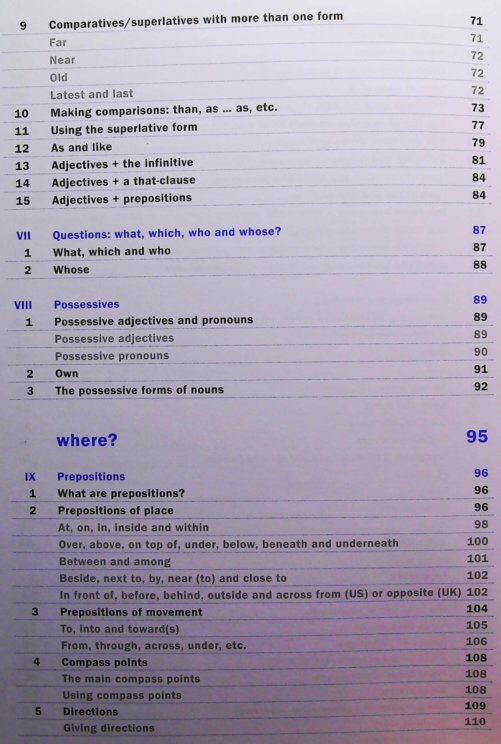
VII. Questions: what, which, who and whose? ••• 87
What, which and who ••• 87
Whose ••• 88
VIII. Possessives ••• 89
Possessive adjectives and pronouns ••• 89
adjectives ••• 89
pronouns ••• 90
Own ••• 91
The possessive forms of nouns ••• 92
IX. Prepositions ••• 96
What are prepositions? ••• 96
Prepositions of place ••• 96
Prepositions of movement ••• 104
To, into and toward(s) ••• 105
From, through, across, under, etc. ••• 106
Compass points ••• 108
The main compass points ••• 108
Using compass points ••• 108
Directions ••• 109
Giving directions ••• 110
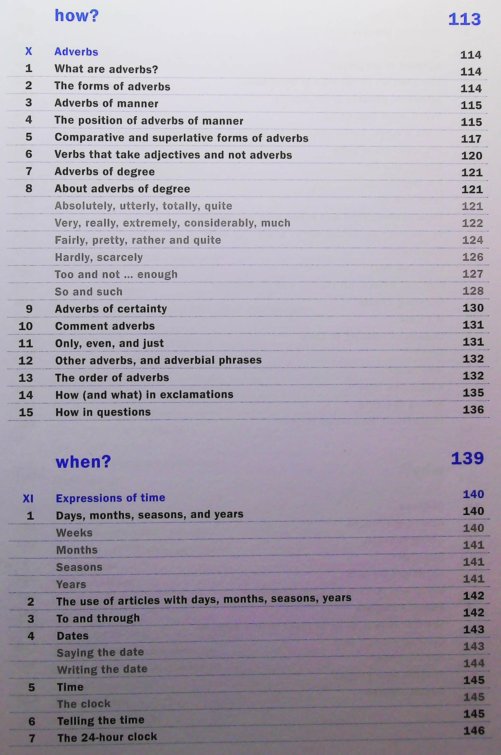
X. Adverbs ••• 114
What are adverbs? ••• 114
The forms of adverbs ••• 114
Adverbs of manner ••• 115
The position of adverbs of manner ••• 115
Comparative and superlative forms of adverbs ••• 117
Adverbs of degree ••• 121
Adverbs of certainty ••• 130
Comment adverbs ••• 131
Other adverbs, and adverbial phrases ••• 132
The order of adverbs ••• 132
How (and what) in exclamations ••• 135
How in questions ••• 136
XI. Expressions of time ••• 139
Days, months, seasons, and years ••• 140
Weeks ••• 141
Months ••• 141
Seasons ••• 141
Years ••• 141
The use of articles with days, months, seasons, years ••• 142
To and through ••• 142
Dates ••• 143
Saying the date ••• 143
Writing the date ••• 144
Time ••• 145
The clock ••• 145
Telling the time ••• 145
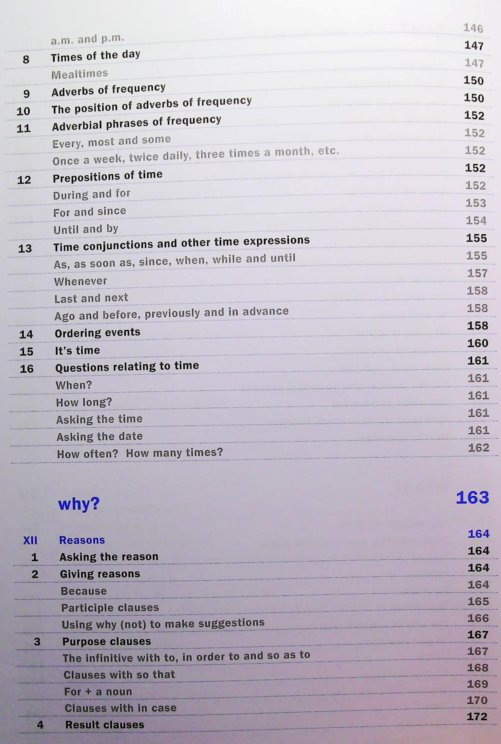
The 24-hour clock ••• 146
XII. Reasons ••• 163
Asking the reason ••• 164
Giving reasons ••• 164
Because ••• 164
Participle clauses ••• 165
Using why (not) to make suggestions ••• 166
Purpose clauses ••• 167
The infinitive with to, in order to and so as to ••• 168
Clauses with so that ••• 169
For + a noun ••• 170
Clauses with in case ••• 172
Result clauses ••• 172
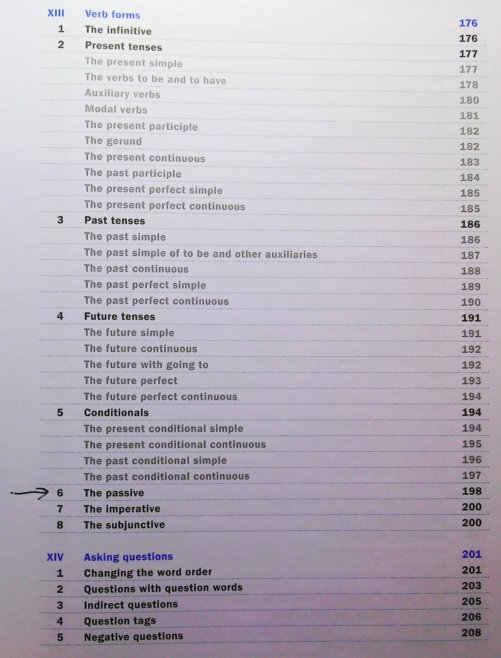
Verb forms ••• 176
1. The Infinitive ••• 176 2. Present Tenses
-
The present simple ••• 177
-
The verbs to be and to have ••• 178
-
Auxiliary verbs ••• 180
-
Modal verbs ••• 181
-
The present participle ••• 182
-
The gerund ••• 182
-
The present continuous ••• 183
-
The present perfect simple ••• 185
-
The present perfect continuous ••• 185
3. Past Tenses
-
The past simple ••• 186
-
of to be and other auxiliaries ••• 187
-
continuous ••• 188
-
perfect simple ••• 189
-
perfect continuous ••• 190
4. Future Tenses
-
The future simple ••• 191
-
continuous ••• 192
-
with going to ••• 192
-
perfect ••• 193
-
perfect continuous ••• 194
5. Conditionals
-
The present conditional simple ••• 194
-
continuous ••• 195
-
simple ••• 196
-
The past conditional continuous ••• 197
6. The Passive
-
The passive ••• 198 7. The Imperative ••• 200 8. The Subjunctive ••• 200
Asking Questions ••• 201
1. Changing the Word Order ••• 201
2. Questions with Question Words ••• 203
3. Indirect Questions ••• 205
4. Question Tags ••• 206
5. Negative Questions ••• 208
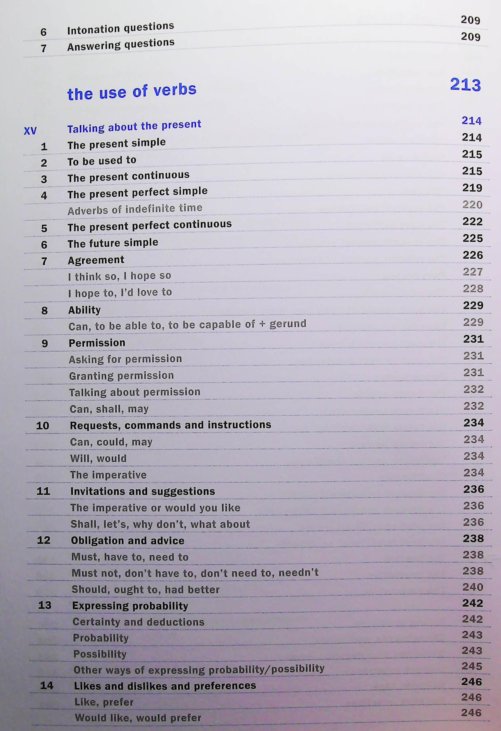
6. Introductory Questions ••• 209
7. Answering Questions ••• 209
The Use of Verbs ••• 213
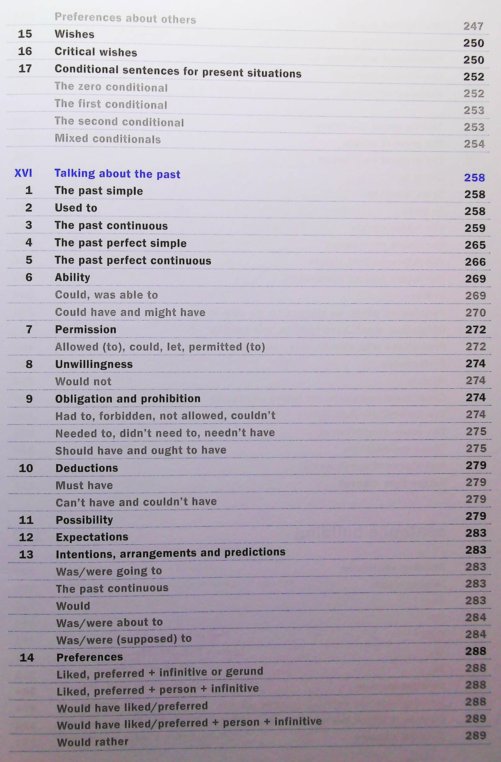
XV. Talking about the Present
-
The present simple ••• 214
-
To be used to ••• 215
-
The present continuous ••• 215
-
The present perfect simple ••• 219
-
Adverbs of indefinite time ••• 220
-
The present perfect continuous ••• 222
XVI. Agreement
-
I think so, I hope so ••• 227
-
I hope to, I’d love to ••• 228
XVII. Ability
-
Can, to be able to, to be capable of + gerund ••• 229
XVIII. Permission
-
Asking for permission ••• 231
-
Granting permission ••• 231
-
Talking about permission ••• 232
-
Can, shall, may ••• 232
XIX. Requests, Commands, and Instructions
-
Can, could, may ••• 234
-
Will, would ••• 234
-
The imperative ••• 234
XX. Invitations and Suggestions
-
The imperative or would you like ••• 236
-
Shall, let’s, why don’t, what about ••• 236
XXI. Obligation and Advice
-
Must, have to, need to, mustn’t, don’t have to, needn’t ••• 238
-
Should, ought to, had better ••• 240
XXII. Expressing Probability
-
Certainty and deductions ••• 242
-
Probability ••• 243
-
Possibility ••• 243
-
Other ways of expressing probability/possibility ••• 245
XXIII. Likes and Dislikes and Preferences
-
Like, prefer + infinitive or gerund ••• 246
-
Would like, would prefer ••• 246
-
Would rather ••• 249
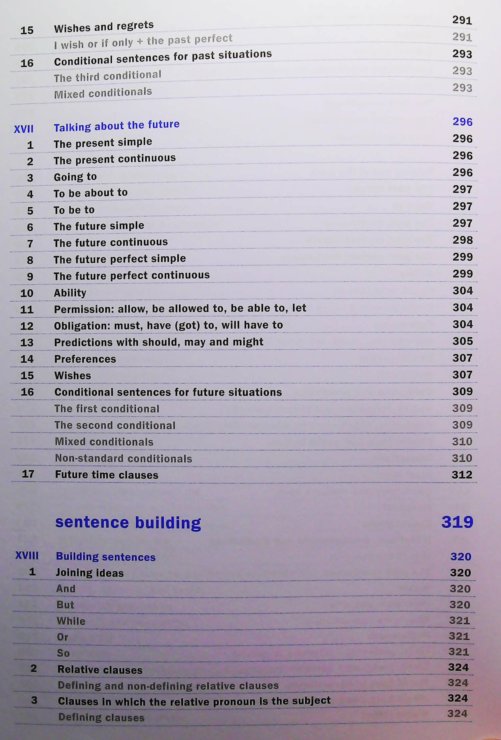
XXIV. Wishes and Regrets
-
I wish if only + the past perfect ••• 291
XXV. Conditional Sentences for Past Situations
-
The third conditional ••• 293
-
Mixed conditionals ••• 293
Talking about the Future ••• 296
1. The Present Simple ••• 296
2. The Present Continuous ••• 296
3. Going to ••• 297
4. To Be About To ••• 297
5. To Be To ••• 297
6. The Future Simple ••• 297
7. Continuous ••• 298
8. The Future Perfect Simple ••• 299
9. The Future Perfect Continuous ••• 299
10. Ability
11. Obligation and Prohibition
-
Permission: allow, be allowed to, be able to, let ••• 304
-
Had to, forbidden, not allowed, couldn’t ••• 274
-
Needed to, didn’t need to, needn’t have ••• 275
-
Should have and ought to have ••• 275
12. Deductions
-
Must have ••• 279
-
Can’t have and couldn’t have ••• 279
13. Expectations ••• 283 14. Intentions, Arrangements, and Predictions
-
Was/were going to ••• 283
-
The past continuous ••• 283
-
Would ••• 283
-
Was/were about to ••• 284
-
Was/were (supposed) to ••• 284
15. Preferences
-
Liked, preferred + infinitive or gerund ••• 288
-
Would have liked/preferred ••• 289
-
Would rather ••• 289
Talking about the Past ••• 258
1. The Past Simple ••• 258
2. Used to ••• 258
3. The Past Continuous ••• 259
4. Perfect Simple ••• 265
5. Perfect Continuous ••• 266
6. Ability
-
Could, was able to ••• 269
-
Could have and might have ••• 270
7. Permission
-
Allowed (to), could, let, permitted (to) ••• 272
8. Unwillingness
-
Would not ••• 274
9. Obligation and Prohibition
-
Had to, forbidden, not allowed, couldn’t ••• 274
-
Needed to, didn’t need to, needn’t have ••• 275
-
Should have and ought to have ••• 275
10. Deductions
-
Must have ••• 279
-
Can’t have and couldn’t have ••• 279
11. Possibility ••• 279 12. Expectations ••• 283 13. Intentions, Arrangements, and Predictions
-
Was/were going to ••• 283
-
The past continuous ••• 283
-
Would ••• 283
-
Was/were about to ••• 284
-
Was/were (supposed) to ••• 284
14. Preferences
-
Liked, preferred + infinitive or gerund ••• 288
-
Would have liked/preferred ••• 289
-
Would rather ••• 289
Sentence Building ••• 319
1. Joining Ideas
-
And ••• 320
-
But ••• 320
-
While ••• 321
-
Or ••• 321
-
So ••• 321
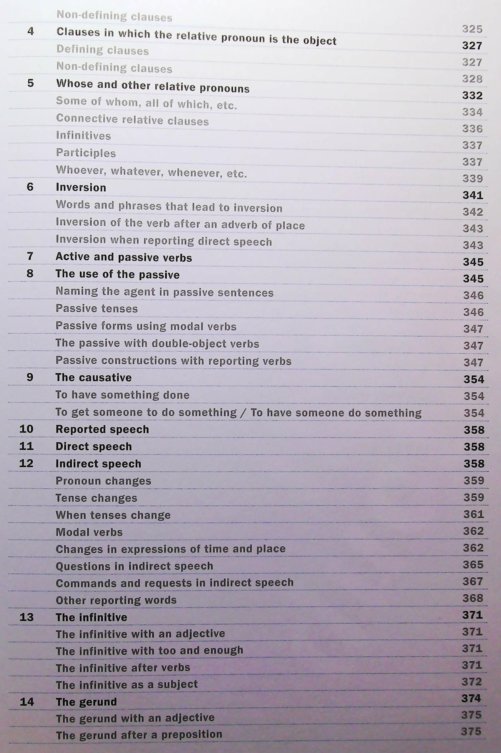
2. Relative Clauses
-
Defining clauses ••• 327
-
Non-defining clauses ••• 328
3. Whose and Other Relative Pronouns
-
Some of whom, all of which, etc. ••• 332
-
Connective relative clauses ••• 334
-
Infinitives ••• 336
-
Participles ••• 337
-
Whatever, whenever, etc. ••• 339
4. Inversion
-
Words and phrases that lead to inversion ••• 341
-
Inversion of the verb after an adverb of place ••• 343
-
Inversion when reporting direct speech ••• 343
5. Active and Passive Verbs
-
The use of the passive ••• 345
-
Naming the agent in passive sentences ••• 346
-
Passive tenses ••• 346
-
Passive forms using modal verbs ••• 347
-
The passive with double-object verbs ••• 347
-
Passive constructions with reporting verbs ••• 347
6. The Causative
-
To have something done ••• 354
-
To get someone to do something / To have someone do something ••• 354
7. Reported Speech
-
Direct speech ••• 358
-
Indirect speech ••• 358
-
Pronoun changes ••• 359
-
Tense changes ••• 361
-
Modal verbs ••• 362
-
Questions in indirect speech ••• 365
-
Commands and requests in indirect speech ••• 367
-
Other reporting words ••• 368
8. The Infinitive
-
The infinitive with an adjective ••• 371
-
The infinitive with too and enough ••• 371
-
The infinitive after verbs ••• 372
-
The infinitive as a subject ••• 372
9. The Gerund
-
The gerund with an adjective ••• 374
-
The gerund after a preposition ••• 375
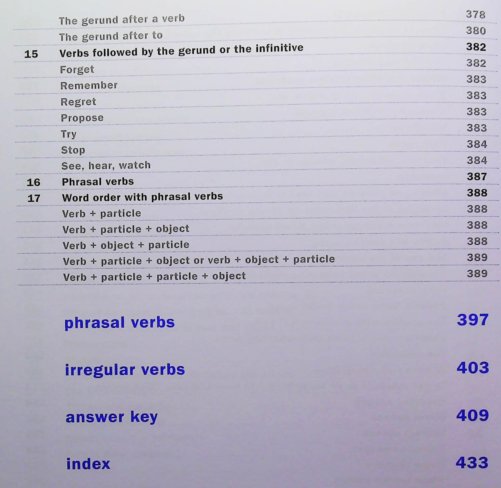
-
The gerund after a verb ••• 378
-
The gerund after to ••• 380
-
Verbs Followed by the Gerund or the Infinitive
-
Forget ••• 382
-
Remember ••• 383
-
Regret ••• 383
-
Propose ••• 383
-
Try ••• 383
-
Stop ••• 384
-
See, hear, watch ••• 384
Phrasal Verbs ••• 397
Irregular Verbs ••• 403
Answer Key ••• 409
Index ••• 433
Collectif
Envoi soigné et Déposé en 48h (jours ouvrables)
Edition Inlingua
17 x 24 x 3,3 cm
440 pages
Dépot légal:2010
Bon état
Avis
Il n’y a pas encore d’avis.